Grok 4.20 Launches with Multi-Agent Architecture, but Where's the Performance Leap?
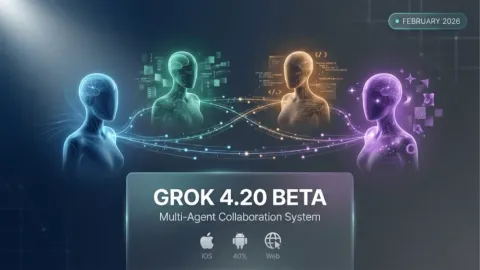
xAI has released Grok 4.20 in beta, featuring a four-agent collaborative system where specialized AI agents handle research, coding, and creative tasks simultaneously. While the architectural approach is novel, the absence of official benchmarks and limited performance gains leave the AI community questioning whether this is genuine progress or just a structural reshuffle.
xAI has released Grok 4.20 in beta. Personally branded as '4.20' by Musk himself, the model finally launched in mid-February 2026 after multiple delays. The core change is a shift from a single-model architecture to a multi-agent system where four specialized agents collaborate.
The architectural innovation is refreshing, but with no official benchmarks released and limited perceived performance gains, reactions have been tepid. In a market where GPT-5, Claude, and Gemini are fiercely competing, where exactly does Grok 4.20 fit?
Grok 4.20's Multi-Agent System: Four Agents Working Together
The defining feature of Grok 4.20 is its multi-agent architecture with four specialized agents operating simultaneously. Instead of a single model handling all requests, role-separated agents work in parallel before integrating their outputs.
The four agents are structured as follows: Grok serves as the coordination agent managing conversation flow, Harper handles research and fact-checking, Benjamin specializes in math, coding, and logical reasoning, and Lucas focuses on creative writing and diverse perspectives. They work concurrently, then run internal peer reviews before generating the final response.
The concept is intriguing. It's an attempt to overcome single-model limitations through architecture, and the peer review mechanism aims to reduce hallucinations. However, whether multi-agent collaboration actually elevates output quality remains unproven.
No Benchmarks, No Evidence of Improvement

Grok 4.20's biggest weakness is the absence of official benchmarks. xAI released no concrete performance metrics with this launch, a stark contrast to competitors who routinely publish detailed benchmarks alongside new models.
The only partial evidence is a +12.11% return in the Alpha Arena stock trading simulation, outperforming GPT-5.1, Gemini 3 Pro, and Claude 3.5 Sonnet. But this is an extremely narrow domain test that hardly represents general AI capability.
Musk himself acknowledged that Grok falls behind Claude in coding tasks. Ultimately, Grok 4.20 is an architecture-focused update rather than a performance leap through parameter scaling or training data expansion. This raises legitimate questions about whether the '4.20' version number promises more than it delivers.
SuperGrok Subscription and 2 Million Token Context

Grok 4.20 is available through the SuperGrok subscription at approximately $30 per month, with the premium Grok 4 Heavy tier at $300 per month. It's accessible across iOS, Android, and web simultaneously, supporting a 2-million-token context window.
The 2-million-token context is a competitive spec. Real-time access to X (formerly Twitter) Firehose data also remains a unique differentiator. However, these features existed in previous versions; the multi-agent structure is essentially the only new addition in 4.20.
The model launched in beta status with no timeline announced for a stable release. API pricing has only been disclosed for Grok 4 (input $3/MTok, output $15/MTok), with 4.20-specific pricing still pending.
Architecture Alone Isn't Enough
Grok 4.20's multi-agent architecture represents a novel approach to AI model design. The concept of four specialized agents collaborating is genuinely interesting and potentially promising in the long run.
But the immediate results fall short of expectations. Claiming 'innovative architecture' without official benchmarks lacks persuasive power. While GPT-5, Claude Opus, and Gemini continue delivering visible performance improvements, Grok 4.20 leaves the impression of a good idea that's yet to be proven. For the multi-agent weapon to demonstrate real firepower, it's time to show the numbers.