OpenAI Doubles Down: 8,000 Employees by Year-End as Anthropic Closes the Gap
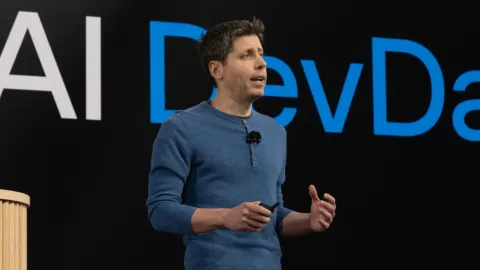
OpenAI plans to nearly double its workforce from 4,500 to 8,000 by end of 2026, a move widely seen as a direct response to Anthropic's rapid rise in the enterprise AI market.
OpenAI has announced plans to nearly double its workforce by the end of 2026. The company aims to grow from its current 4,500 employees to 8,000, according to a Financial Times report on March 21. This isn't just routine hiring — it's a signal that the AI industry's competitive landscape is fundamentally shifting.
The Numbers Behind the Urgency
OpenAI's hiring spree spans product, engineering, research, sales, and even a newly created role called "Technology Ambassador." The company has secured over one million square feet of office space in San Francisco, and its valuation stands at $840 billion.
But behind this outward expansion lies an uncomfortable reality. OpenAI's share of enterprise AI spending has plummeted from 50% to 27%. On the other side of the ledger, Anthropic has surged to 40%.
How Anthropic Flipped the Script
Ramp's March 2026 AI Index delivered a bombshell: 70% of companies making their first AI purchase are choosing Anthropic's Claude. This isn't about retaining existing customers — it's about new market entrants, which makes the statistic all the more significant.
Anthropic's annualized revenue has reached $19 billion, growing at 10x year-over-year. OpenAI's growth rate over the same period stands at 3.4x.
While OpenAI still leads in absolute revenue, the growth velocity gap suggests a reversal may be a matter of when, not if. The most painful data point for OpenAI: Claude is becoming the default choice in enterprise AI.

Acquisitions to Fill the Gaps
OpenAI is supplementing its hiring push with strategic acquisitions. The company acquired Astral, a Python developer tools firm, to strengthen its developer ecosystem, and Promptfoo, an AI security startup, to address enterprise customers' most sensitive concern.
Adding to its enterprise offensive, OpenAI launched Frontier, a platform for building and managing AI agents. By offering tools that go beyond simple API access and embed deeply into corporate workflows, OpenAI is constructing a defensive moat around its B2B business.

The Y-Axis-Free Chart and Community Backlash
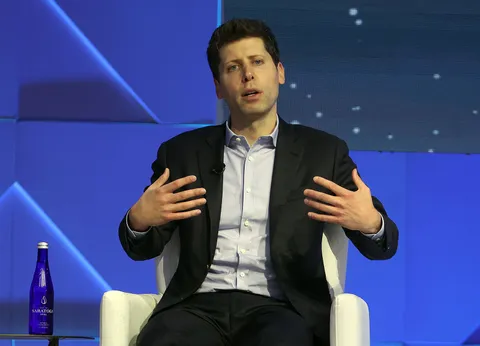
CEO Sam Altman reiterated his vision to "flood the world with intelligence." But the community response has been skeptical. A chart Altman shared to showcase OpenAI's growth was missing Y-axis values — a detail that quickly became a meme, with critics suggesting it was a deliberate attempt to obscure actual figures.
Meanwhile, the developer community increasingly views Claude as the emerging enterprise default. Claude's preference among coding agent users, longer context window support, and Anthropic's more transparent corporate culture are cited as key trust drivers.
What 8,000 People Can and Cannot Change
Doubling headcount doesn't automatically recover market share. OpenAI's real challenge isn't workforce size — it's accurately diagnosing and responding to why enterprise customers are choosing Anthropic.
Pricing, performance, safety, enterprise-friendly policies — these are the areas Anthropic is rapidly filling. How OpenAI differentiates in these domains will be the defining storyline of the second half of 2026. The entire AI industry is watching whether 8,000 employees translate into genuine competitive advantage or mere scale theater.