
OpenAI Cuts Data Center Target by 57%: A Signal That AI's Investment Fever Is Breaking
While raising a $100B+ funding round, OpenAI quietly slashed its compute target from $1.4T to $600B. From circular financing to efficiency breakthroughs and market share erosion, AI's investment fever is entering a correction phase.
Raising $100 billion while simultaneously lowering your target. It sounds contradictory, but that's exactly what OpenAI did in February 2026. In the midst of the largest funding round in history, it quietly told investors it was cutting its computing infrastructure investment target from $1.4 trillion to $600 billion—a 57% reduction.
This isn't a simple number adjustment. It's an admission, delivered while asking for more money, that the original plan was too ambitious. It's the moment AI's investment fever collided with reality.
The DeepSeek Shock: 'Scale Equals Victory' No More

The most fundamental driver behind the cut is a technological paradigm shift. DeepSeek V3.2 achieved GPT-5-level performance at 10 to 30 times lower cost. The implication is clear: the assumption that massive-scale compute is the only path to AGI is crumbling.
If the computing resources needed for equivalent performance are shrinking rapidly, $1.4 trillion in infrastructure becomes overinvestment. This realization spread within OpenAI itself—growing skepticism that unconditional scale-up was necessarily the right answer.
The irony is that OpenAI publicly downplayed DeepSeek while internally using it as justification for revising its investment strategy. Efficiency innovation is both an ally—reducing costs—and a threat, since it simultaneously lowers the barriers for competitors.
Nvidia's Circular Financing: When Your Investor Is Your Supplier

A closer look at the funding round's structure reveals an uncomfortable picture. Nvidia is investing $30 billion, Amazon $50 billion, and SoftBank $30 billion—a record-breaking round valuing OpenAI at $730 billion pre-money.
But here's the core problem: Nvidia invests $30 billion in OpenAI, and OpenAI spends a significant portion of that buying Nvidia GPUs. The invested money flows back as revenue. This isn't genuine external capital injection—it's money circulating within a single ecosystem.
The risk is that if one side falters, both collapse. If OpenAI's GPU demand drops, Nvidia's revenue takes a hit; if Nvidia's investment appetite weakens, OpenAI's fundraising suffers. For investors, this circular structure could mean an inflated valuation disconnected from real enterprise value. OpenAI's reduced target is partly an attempt to address these external doubts.
Stargate's Reality: Only 10% Confirmed

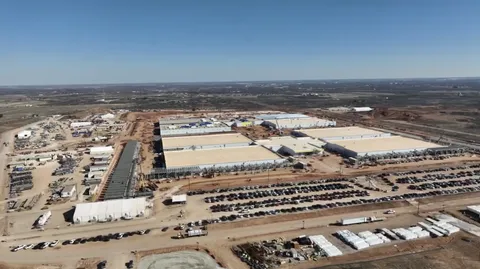
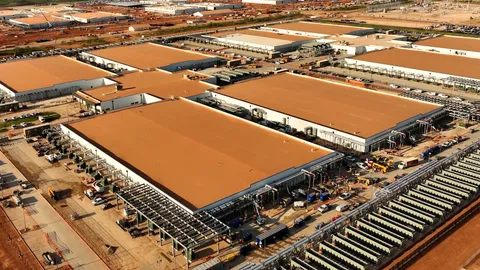
The Stargate project's reality also underpins the revision. Of the $500 billion announced, only $52 billion is confirmed—just 10%. Construction has begun in Texas and five new sites have been added, but that's still early stages against a 20-datacenter goal.
Key partner Oracle faces credit downgrade risk from massive debt fundraising. SoftBank had to urgently sell Nvidia and T-Mobile stakes to cover payments. With project partners themselves financially strained, maintaining a $1.4 trillion target would have been more alarming than reassuring to investors.
Market Share Erosion: The Investment Logic Unravels

According to Bloomberg, ChatGPT's AI chatbot market share has plunged from 69.1% to 45.3%. Google's Gemini surged from 14.7% to 25.2%, and Elon Musk's Grok rocketed from 1.6% to 15.2%, rapidly eating into OpenAI's dominance. Anthropic's Claude is also expanding its enterprise footprint. The Big Four tech companies invest $635-700 billion annually in AI infrastructure—all building their own models.
A $1.4 trillion investment only makes sense if it presumes OpenAI can dominate the market long enough to recoup it. With market share now below 50%, investors began questioning that premise. The reduced target is OpenAI's answer to their doubt.
The Musk Lawsuit and IPO Uncertainty

Legal risk is also weighing on investor sentiment. Elon Musk's lawsuit goes to trial March 30, 2026, seeking up to $134 billion in damages over alleged betrayal of nonprofit principles. Win or lose, it compounds uncertainty around OpenAI's for-profit conversion and IPO timeline.
With cumulative losses projected at $115 billion through 2029, the IPO is investors' key exit strategy. If the lawsuit delays it or worsens conditions, the foundation beneath the $730 billion valuation starts to crack. Maintaining a $1.4 trillion ambition under these circumstances would have looked like escalating risk rather than building confidence.
AI Investment's Bubble Is Meeting Reality
OpenAI's reduced target isn't a single event—it's a turning point. Efficiency breakthroughs are diminishing the need for massive compute. Intensifying competition is undermining monopolistic return assumptions. Doubts about circular financing are growing. All of these forces are converging to test the AI industry's golden rule: 'whoever spends more, wins.'
Six hundred billion dollars is still astronomical, and OpenAI remains the AI company attracting the most capital. But cutting your target by more than half in three months is an unmistakable signal: AI investment's bubble is meeting reality.

- CNBC - OpenAI scales back computing ambitions, cuts spending target to $600 billion
- Reuters - Stargate AI project secures $52B in confirmed funding
- The Wall Street Journal - Big Tech's AI spending spree faces reality check
- Bloomberg - OpenAI's $100B funding round draws Nvidia, Amazon interest
- Bloomberg - OpenAI's Market Share Drops Below 50% as Rivals Gain Ground