
Stargate: Will OpenAI's $500B Bet Become the Next NEOM?
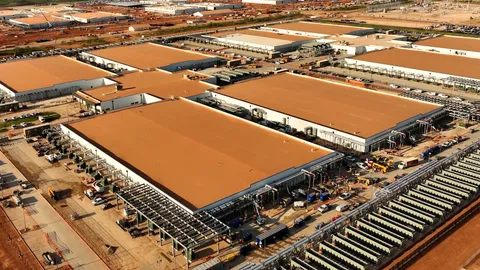
OpenAI's $500B Stargate project faces a triple threat: investor flight, partner financial woes, and a global memory crisis. Will it follow NEOM's path—a project that ballooned from $1.6T to $8.8T before scaling back?
In January 2026, Saudi Arabia announced a massive scale-back of NEOM. Initially projected at $1.6 trillion, costs ballooned to an estimated $8.8 trillion before reality forced a retreat. The 170km linear city 'The Line' was downsized, and the 2029 Asian Winter Games were postponed indefinitely.
At the same time, another trillion-dollar mega-project is showing similar warning signs: OpenAI's $500 billion Stargate.
OpenAI Could Run Out of Cash by Mid-2027

According to a New York Times analyst, OpenAI could run out of cash by mid-2027. Projected losses for 2026 alone are $14 billion. By 2029, cumulative cash burn is expected to reach $115 billion—$80 billion more than initially projected.
Revenue is growing explosively: $20B+ annual revenue in 2025, 900 million weekly active users. But spending is outpacing earnings. Stanford professor Rob Siegel warns: "If investors lose faith, things could collapse quickly."
To make matters worse, Elon Musk has filed a lawsuit seeking $79-134 billion in damages from OpenAI and Microsoft. Trial is scheduled for April 2026. His claim: betrayal of nonprofit principles. Regardless of outcome, it adds uncertainty to OpenAI's for-profit conversion and IPO plans.
SoftBank CFO Officially Confirms Stargate Delays

In August 2025, SoftBank CFO Yoshimitsu Goto officially acknowledged during an earnings call: "It's taking a little longer than our initial timeline." Site selection, stakeholder coordination, and energy issues are holding things back.
In Northern Virginia, the nation's largest data center hub, grid connection delays of 7 years are being reported. Data centers are electricity-hungry monsters. But there's no electricity.
Investors are pulling out. JPMorgan Chase led a $38 billion debt raise but is failing to find investors for two of the first five data centers. The goal was 20 data centers—they can't even fill two.
Oracle faces credit downgrade risk. Its stock has fallen by over a third since November. SoftBank had to urgently sell Nvidia and T-Mobile stakes to make a $22.5 billion payment. Jefferies analysts scoffed: "The data center honeymoon is over."
Memory Crisis: A Self-Inflicted Wound

The irony is that Stargate is driving up its own costs.
In October 2025, OpenAI signed a strategic partnership with Samsung Electronics and SK Hynix. This alone will consume 900,000 wafers monthly—about 40% of global DRAM production. Google, Amazon, Microsoft, Meta, and all the world's PC and smartphone manufacturers must share the remaining 60%.
The result? DRAM prices surged 172% in 2025. The problem is that Stargate must purchase 40% of the world's memory at these inflated prices. Each data center requires tens of millions of dollars in memory—and that unit cost is rising over 50% every quarter.
Micron's Sumit Sadana declared: "2026 is completely sold out." By trying to secure memory, they've caused prices to explode—and those costs are boomeranging back to the project. Stargate's infrastructure costs are growing exponentially.
Gamers and Consumers Pay the Price

Dell Technologies COO Jeff Clarke said: "We've never seen costs escalating at this pace." Consumer price increases are inevitable. Morgan Stanley downgraded Dell stock.
Gaming PCs took a direct hit. Memory cost ratio for high-capacity gaming PCs has exceeded 30%, up from 10-18% in H1 2025—nearly doubled. In Tokyo's Akihabara, retailers have started limiting memory purchases.
Parallels with NEOM
NEOM ($8.8T estimated) and Stargate ($500B) differ in scale, but share key parallels. Both hit reality walls after grand announcements. Both are suffering from cost overruns and delays. NEOM ultimately announced massive scale-backs.
Stargate, however, has some encouraging signs. OpenAI is currently running a $100B funding round, with Amazon negotiating up to $50B and other big tech companies actively participating.
OpenAI's Next Model Will Decide Stargate's Fate
OpenAI is still growing. Revenue tripled, 900M users, $40B funding completed. But Google's Gemini and Anthropic's Claude are catching up fast. GPT-5 fell short of expectations, and enterprise market share dropped from 50% to 27%. OpenAI's fate now rests on upcoming models Garlic and Shallot.
If OpenAI fails to prove with Garlic and Shallot that 'AI will change the world'—their own words—everything could turn to dust.
- SF Examiner - Why OpenAI faces massively critical year ahead in 2026
- NetworkWorld - Stargate's slow start reveals the real bottlenecks in scaling AI infrastructure
- Reuters - Musk seeks up to $134 billion from OpenAI and Microsoft
- Euronews - NEOM no more? Saudi Arabia reduces ambitious plans for The Line
- Tom's Hardware - OpenAI could reportedly run out of cash by mid-2027
- Business Insider - Oracle and OpenAI's AI data centers buildout needs $500 billion