Cursor Teases From-Scratch Frontier Model

Cursor teased a new frontier model at Compile — trained from scratch, no Kimi base, with 10–20x Composer's compute. It ships within weeks.
Cursor has teased a new proprietary AI model. The announcement was made at Compile, the company's invite-only conference held on June 16 at Fort Mason in San Francisco. The details first emerged when Nick Dobos, a longtime Cursor power user, summarized the on-stage presentation in a post on X.
According to Dobos's readout, the new model matches the scale of Claude Opus and GPT-5.5. It is trained from scratch without the Kimi base, utilizes 10 to 20 times the compute of Composer, and features general intelligence rather than code-only specialization. The launch is expected within the next few weeks.
The teaser marks a bold declaration: a company that began as a VS Code fork now intends to build a frontier model from scratch. Therein lies the significance of the announcement.
Moving Beyond the Kimi Base
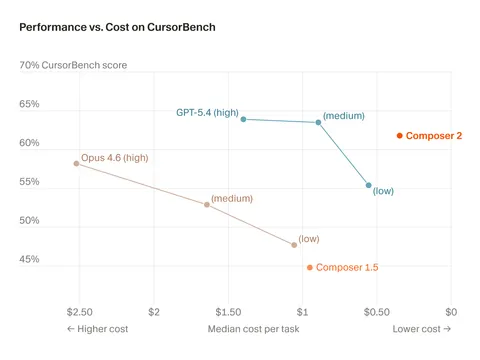
The promise of a model trained 'from scratch' carries weight precisely because of Cursor's recent history. While the March release was marketed as offering 'frontier-level coding intelligence,' the company omitted the fact that it was based on Kimi K2.5, an open-source model developed by China's Moonshot AI.
The omission was quickly uncovered. An X user named Fynn identified the Kimi foundation by spotting an unedited model ID in the API, dryly posting, 'at least rename the model ID.' As reported by TechCrunch, Cursor's Lee Robinson acknowledged that the model 'started from an open-source base,' but clarified that 'only about a quarter of the final compute came from the base,' with the remainder coming from their own post-training.
The crux of the matter lies in co-founder Aman Sanger's response. He admitted it was 'a miss to not mention the Kimi base in our blog from the start' and promised, 'we'll fix that for the next model.' The latest announcement appears to fulfill that pledge by moving away from Kimi entirely.
SpaceXAI and Colossus 2

How will Cursor secure the computational power required to deliver on this promise? The company had already hinted at the answer in May when it released Composer 2.5, noting in a blog post that it was 'training a significantly larger model from scratch, together with SpaceXAI, using 10x more total compute.'
The scale of this SpaceXAI infrastructure is massive. The project combines Cursor's proprietary data and training methods with Colossus 2, a cluster comprising approximately one million H100-equivalent GPUs. The '10-20x' compute increase cited by Dobos appears to stem from the SpaceXAI partnership.
This is no routine model bump. An IDE that once wrapped and resold APIs from OpenAI and Anthropic is transitioning into an AI lab, abandoning third-party foundations to train its own frontier model on SpaceXAI's cluster-scale compute. Coupled with acquisition rumors that surfaced the same week, all eyes are on the next move from a startup valued at $29.3 billion in its Series D round with an annual run rate exceeding $2 billion.
Coding Skill Alone Won't Cut It
The most notable detail in this roadmap is the shift toward 'general' intelligence. The final point in Dobos's summary indicated that the new model will be 'generally intelligent, not just coding.' Cursor, which previously focused on running specialized Composer coding models quickly and cost-effectively, is now signaling its ambition to develop a full-fledged general frontier model.
For now, these plans remain tentative. Cursor has not yet shared benchmarks, pricing, or a firm release date. Having faced skepticism during the release of Composer 2, the company will likely face intense scrutiny from a market watchful of the gap between marketing claims and real-world performance.
Still, the direction is clear: move away from the Kimi base, scale compute by 10 to 20 times, and expand beyond code generation. Fulfilling the promised release within the next few weeks will be the company's first major test.