Composer 2.5 Lands on Grok Build: xAI-Cursor Tie
xAI added Cursor's Composer 2.5 to Grok Build on June 1 — an external model that out-codes its own. The first product signal of the SpaceX-xAI-Cursor stack.
On June 1, xAI announced the integration of Cursor's Composer 2.5 coding model into its proprietary coding CLI, Grok Build. SuperGrok and X Premium+ subscribers can now select the model directly from the /model menu.
The deployment of an external model is notable: Composer 2.5 is a specialized coding model developed by Cursor, a firm previously viewed as a competitor. By embedding Cursor's model, xAI has introduced a third-party tool into its own ecosystem that outperforms its proprietary models on standard coding benchmarks.
Performance Gap: Composer 2.5 Outpaces xAI's Engine

Released by Cursor on May 18, Composer 2.5 is a specialized coding model built on the open-source Kimi K2.5 checkpoint and refined using large-scale reinforcement learning. The model achieved a score of 79.8% on the SWE-Bench Multilingual benchmark and 63.2% on Cursor's proprietary CursorBench v3.1. That places it alongside industry-leading frontier models such as Opus 4.7 and GPT-5.5.
In contrast, Grok Build's default model, grok-build-0.1, registers a score of 70.8% on SWE-Bench Verified. While differences in benchmarking methodologies warrant caution in direct comparisons, Composer 2.5 remains significantly closer to the top tier of frontier models, which typically score in the 87% to 88% range.
| Model | Coding benchmark | Price (per 1M, in/out) |
|---|---|---|
| Composer 2.5 | SWE-Bench Multilingual 79.8% · CursorBench 63.2% | $0.50 / $2.50 |
| grok-build-0.1 | SWE-Bench Verified 70.8% | $1.00 / $2.00 |
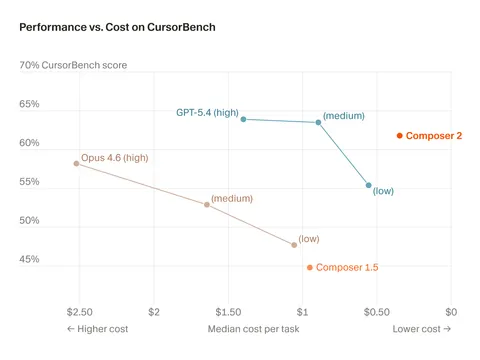
The cost disparity is even more pronounced. Composer 2.5 is priced at $0.50 per million input tokens and $2.50 per million output tokens, representing approximately one-tenth the cost of comparable frontier models. Its predecessor, Composer 2, similarly outpaced Opus 4.6 while maintaining the same cost-efficiency.
Consequently, xAI has directly provided developers using its CLI with a more cost-effective and capable programming tool.
Spur to Integration: The SpaceX-Anysphere Acquisition Option

Integrating a more cost-effective rival model within a proprietary CLI is atypical, but it reflects the shared corporate umbrella connecting the entities. xAI completed its merger with SpaceX in February 2026, and Composer 2.5 was trained using xAI's Colossus 2 supercomputing cluster. The model is less an external acquisition and more a product of shared infrastructure.
Financial relationships are also tightening. In April, SpaceX secured an option to acquire Anysphere, the developer of Cursor, for $60 billion. This option becomes exercisable approximately 30 days after SpaceX's planned initial public offering (IPO) on June 12, and it carries a $10 billion termination fee if the transaction is not completed.
The combination of xAI's corporate integration with SpaceX, Composer's development on shared computing infrastructure, and the potential acquisition of Cursor aligns these entities toward a singular goal. The integration of Composer 2.5 into Grok Build is the initial product-level manifestation of this corporate alignment.
Bi-directional Technology Exchange
This integration is not one-sided. Simultaneously, Grok Build's proprietary grok-build-0.1 model was added to Cursor's model selection menu. By incorporating each other's technologies, both ecosystems have initiated a bi-directional exchange of artificial intelligence assets.
Early feedback from developers has been positive. Given its high speed and low cost, Composer 2.5 has already emerged as the preferred default option among Cursor users, while Grok Build subscribers welcome the addition of a more powerful programming tool. This mutual integration has heightened expectations for broader collaborative efforts in the future.
Several uncertainties remain. Grok Build is currently in beta, and accessing Composer 2.5 requires a premium tier such as SuperGrok Heavy, which costs $99 per month and will rise to $300 after six months. Additionally, the $60 billion acquisition option depends on the completion of SpaceX's IPO scheduled for June 12. Nevertheless, the formal inclusion of a competing model in a proprietary CLI provides the strongest evidence yet that the theoretical synergies among the three companies are translating into tangible product features.