Gemma 4 12B: An Encoder-Free Multimodal Model
Google's Gemma 4 12B runs locally on a 16GB laptop yet nears its 26B MoE, dropping multimodal encoders and shipping with Multi-Token Prediction by default.
On June 3, Google DeepMind released Gemma 4 12B, an open-weight AI model designed to run locally on consumer laptops with 16GB of memory while delivering performance comparable to the larger 26B MoE model.
The new 12B model fills the gap between Google's lightweight edge model E4B and the high-performance 26B MoE. Google positions the model as a balance of capability and efficiency, noting it is the first mid-sized Gemma model to natively support audio input.
An Encoder-Free, Unified Multimodal Architecture

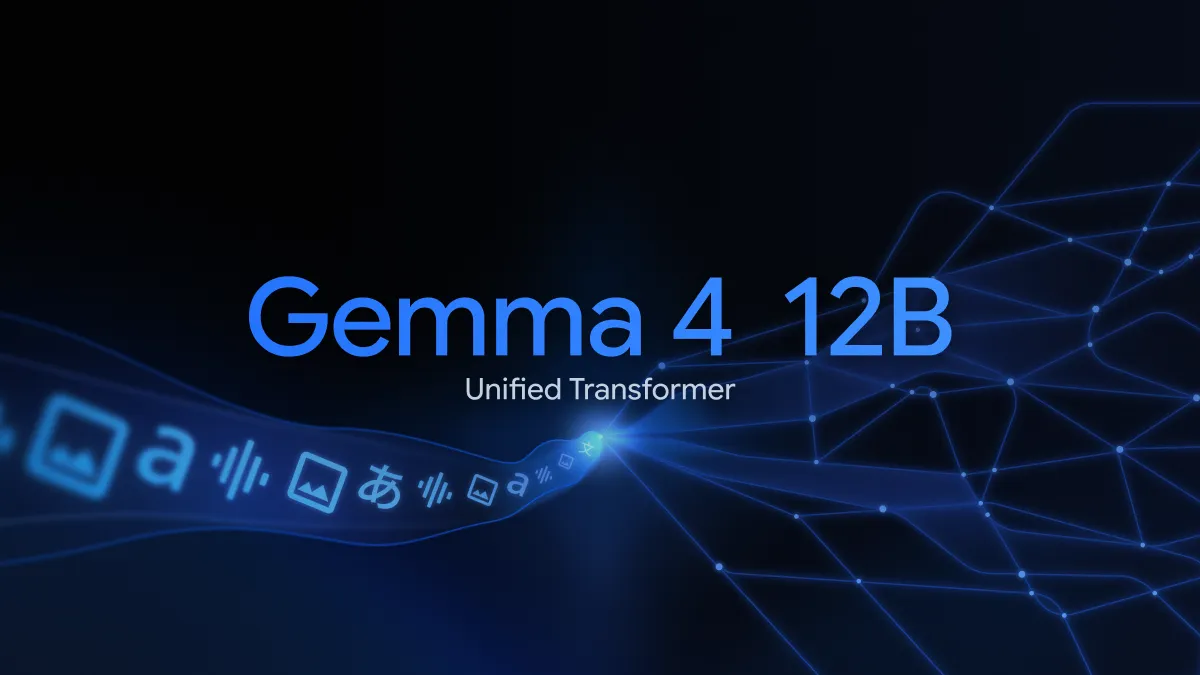
These native audio capabilities stem from Gemma 4 12B's architectural design. Conventional multimodal models route images and audio through dedicated encoders before feeding them to the language model. That step adds latency and memory overhead, so Google eliminated these encoders entirely.
For visual processing, the heavy vision encoder gives way to a lightweight embedding module. It consists of a single matrix multiplication, positional embedding, and normalization layers, letting the LLM backbone process visual data directly. Audio is handled even more simply. The raw audio signal is projected straight into the same dimensional space as text tokens.
Google calls this an encoder-free architecture. By skipping the intermediate conversion step, the encoder-free architecture trims both latency and memory consumption, laying the groundwork for on-device multimodal AI, according to Google's official blog.
Local Inference on Consumer Laptops with Built-In MTP

This reduced memory footprint, the payoff of the encoder-free architecture, translates directly into lower hardware requirements. Gemma 4 12B approaches the benchmark performance of the 26B MoE model while using less than half the memory. That lets on-device multimodal AI inference run locally on laptops with 16GB of RAM or unified memory. The downloadable model weights total roughly 18GB.
To improve generation speed, the model integrates a Multi-Token Prediction (MTP) drafter by default. It leverages idle compute cycles to pre-calculate likely future tokens. Google has offered Multi-Token Prediction as an option for other Gemma 4 models, but the 12B variant is the first to ship it out of the box.
Pairing Multi-Token Prediction with the encoder-free architecture lets demanding work run locally. Multi-step reasoning and agentic workflows that once required larger Gemma models now fit on a laptop. While the closed-source flagship Gemini 3.1 Pro keeps pushing the performance ceiling, the open-weight Gemma 4 12B pulls those capabilities down onto consumer hardware.
Expanding an Ecosystem of 150 Million Downloads
Designed for local accessibility, Gemma 4 12B is an open-weight model distributed under the commercially permissive Apache 2.0 license, with weights immediately available on Hugging Face and Kaggle. Users can also run the model without local downloads via platforms like LM Studio, Ollama, and the Google AI Edge Gallery.
The model supports standard inference pipelines including Hugging Face Transformers, llama.cpp, MLX, vLLM, and SGLang, and can be fine-tuned efficiently using Unsloth. For cloud deployment, it integrates with Google Cloud's Model Garden, Cloud Run, and Google Kubernetes Engine (GKE).
With cumulative downloads for the Gemma 4 family exceeding 150 million, Google continues to expand its open-weight ecosystem. While proprietary models compete at the high end, Gemma 4 12B is a practical step toward democratizing advanced on-device AI on standard consumer laptops.